"I am trying to check my habits of seeing, to counter them for the sake of greater freshness. I am trying to be unfamiliar with what I'm doing." - John Cage


Monday, November 5, 2012

30 Poems in 30 Days: Day Five Prompt


Ordinary
Barry Lopez: When I was photographing, I used to ask other landscape photographers to consider that the Sierra Club and Audubon calendars they were shooting for were not all that different from the Playboy calendars these photographers would never associate themselves with. They were consciously trying to create gorgeous, overwhelming images. They created them in response to an ideal about the beauty of landscape that was, qualitatively I think, no different from men choosing certain types of bodies and arranging them in certain kinds of poses to mirror a set of expectations that American men associate with erotic feminine beauty. Some people were outraged by the suggestion, but I would make it anyway. My argument was, “You say that you want to see landscapes preserved, but what you’re photographing are the voluptuous landscapes, so I’m having trouble believing this if there are no photographs of the beauty inherent in an ordinary landscape.” This is one of the ways advertising and public relations have compromised art and writing, you know, in the twentieth century. Advertising has become a force for corruption, in my mind, as far as language and imagery are concerned. As time goes by, it’s an industry I’ve come to have little respect for, although I have known people working in advertising whom I still hold in some regard. I’ve worked in it myself. It’s just become so compromised.
1.     Write about an ordinary landscape, some place where we wouldn't think "nature" at first.  The scrap of grass behind the Safeway dumpsters. The urban creek full of highway runoff running along the street. Just regular and ordinary. Can you find a place that isn't advertising anything. Is there beauty inherent in it? Is there a larger significance?

Sunday, November 4, 2012

30 Poems in 30 Days: Day Four Prompt


The Glimmer

“It’s an image, but it’s an image that has a kind of a ‘glimmer’ to it that suggests itself as worthy of being written about and of having metaphoric potential.  I don’t really want to know what that metaphoric potential is.  I just know that it glimmered at me.  I don’t want to think too much about that, because I don’t want to use this brain- that big analyzer – because I don’t want it to lose its magic its power, before I’ve had a chance to combine it with other unlike objects.” – Pam Houston

“For me, the combining of those glimmers is what makes the potential of a story different from the potential of real life.  If you go out in a boat in Alaska and see a pod of orcas, that’s a really powerful experience.  And there’s no way that language is going to live up to that: theres’ no way that I can describe that in a way that is going to be better than the experience of someone actually going out and seeing the orcas.  But if I can put those orcas next to a conversation about, oh, let’s say imminence and eminence, some conversation that’s got tricky word play in it; if I can put that next to a seven year old with three dozen balloons, well, all of a sudden I might have something.  ..And then I can make something explosive and beautiful in its own way that is no longer dependent on what it feels like in a boat to be with those orcas.  It’s about the combination of the orca and the burrowing owls and the little girl with the balloons.  So I go in there, with what I think of as legitimate pieces, these glimmer things, and I know they all have power.” – Pam Houston
Make a list of glimmery things in your life.  Think of moments of travel. Places.  Animals you’ve seen.  Objects, a view, two minutes of overheard conversation, an image that seems incredible.  In the list, describe each one in a paragraph.
Now choose three separate "glimmers" to connect in a little vignette.  Don’t think and don’t analyze.  Just write and surprise yourself as they come together without effort.

Saturday, November 3, 2012

30 Poems in 30 Days: Day Three Prompt

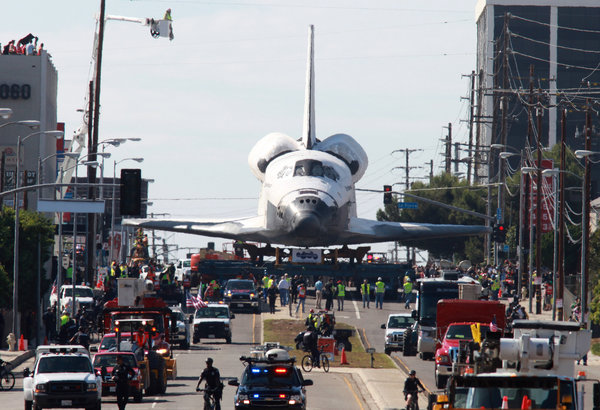
Amid the festive atmosphere, people reveled in being so very close to the hulking vehicle that had traveled so very far away.
“It’s interesting to see how much wear it’s taken after all its journeys,” Greg Bristol, 69, said. “It’s got burn marks on it. It’s got missing tiles. It’s been through hell.”
As the Endeavour began to inch away from the parking lot (at top speeds of 2 miles per hour), people clapped and shouted, “It’s moving!” The shuttle’s wings — 78 feet from tip to tip — just barely fit between the buildings on either side of the street. - New York Times, 10/12/12
What I find interesting in this article is how these spectators are finding ways to connect with the shuttle, despite its mammoth size and non-living status, on a personal level.  It has burn marks and it's been through hell - why is this remarkable to the man?  Because of his own burn marks, maybe?

Write about something unfamiliar, out of place, from a place far far from your place, that is now in your place.  Does it have marks on it from its travels? Has it been through hell? If it isn't alive, try writing about it as if it is alive.

http://www.nytimes.com/2012/10/13/us/space-shuttle-endeavour-rolls-through-los-angeles.html?adxnnl=1&adxnnlx=1351993820-QD6PuT8MS3TJ4bdvGWgRVg&_r=0

Friday, November 2, 2012

30 poems in 30 days: Day Two Writing Prompt


Writing without Guilt
 One morning as I brushed my teeth, a spider crawled out of the drain.  It's long legs were almost furry.  I turned on the water, spit out my toothpaste, and watched the spider spin down the drain.  After I dried my face, I turned back to the mirror, and there was the spider, crawling up the sink.  I turned on the faucet again.  His legs curled under him in the universal sign of dead spider as he washed away.  What happened? A few minutes later, the spider appeared in the sink.  What did I do?   I turned on the water again. 

Write about something that you have killed, and do not include any guilt in your story.

Thursday, November 1, 2012

30 poems in 30 days: Day One Prompt

Morning Song

I wake up at 4 am to chalky light from the moon through the high narrow window above my bed. Sometimes when you can't sleep through the night, again and again, it helps to remember you aren't alone as an unskilled sleeper.  In fact, there is a whole form in poetry dedicated to this time of day, early morning, just before sunrise.  The aubade is defined by The Poetry Foundation as a love poem or song welcoming or lamenting the arrival of the dawn, originating in medieval France.  While John Donne's "The Sun Rising" is a traditional example, I read Phillip Larkin's aubade below and felt a closer connection, especially with the first 4 lines of the last stanza. Although his poem is quite dark, see Louise Bogan's "LeaveTaking" for an aubade with a very different tone.

I'll be posting a new writing prompt each day of November to support my fundraising efforts for The Center for New Americans. Today's writing prompt is to write a welcome or a lament to the morning.  You can use Larkin's poem as a model or an antithesis of your poem.  Happy writing!


Aubade by Phillip Larkin

 
I work all day, and get half-drunk at night.   
Waking at four to soundless dark, I stare.   
In time the curtain-edges will grow light.   
Till then I see what’s really always there:   
Unresting death, a whole day nearer now,   
Making all thought impossible but how   
And where and when I shall myself die.   
Arid interrogation: yet the dread
Of dying, and being dead,
Flashes afresh to hold and horrify.

The mind blanks at the glare. Not in remorse   
—The good not done, the love not given, time   
Torn off unused—nor wretchedly because   
An only life can take so long to climb
Clear of its wrong beginnings, and may never;   
But at the total emptiness for ever,
The sure extinction that we travel to
And shall be lost in always. Not to be here,   
Not to be anywhere,
And soon; nothing more terrible, nothing more true.

This is a special way of being afraid
No trick dispels. Religion used to try,
That vast moth-eaten musical brocade
Created to pretend we never die,
And specious stuff that says No rational being
Can fear a thing it will not feel, not seeing
That this is what we fear—no sight, no sound,   
No touch or taste or smell, nothing to think with,   
Nothing to love or link with,
The anaesthetic from which none come round.

And so it stays just on the edge of vision,   
A small unfocused blur, a standing chill   
That slows each impulse down to indecision.   
Most things may never happen: this one will,   
And realisation of it rages out
In furnace-fear when we are caught without   
People or drink. Courage is no good:
It means not scaring others. Being brave   
Lets no one off the grave.
Death is no different whined at than withstood.

Slowly light strengthens, and the room takes shape.   
It stands plain as a wardrobe, what we know,   
Have always known, know that we can’t escape,   
Yet can’t accept. One side will have to go.
Meanwhile telephones crouch, getting ready to ring   
In locked-up offices, and all the uncaring
Intricate rented world begins to rouse.
The sky is white as clay, with no sun.
Work has to be done.
Postmen like doctors go from house to house.